

Monorail Conveyor

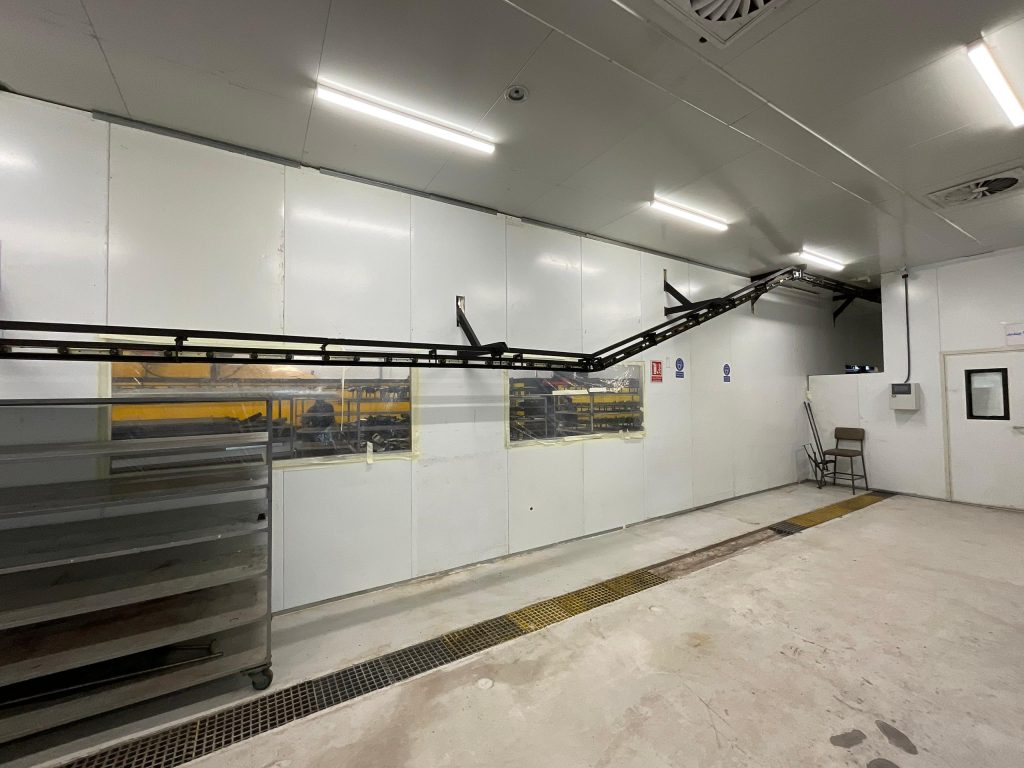
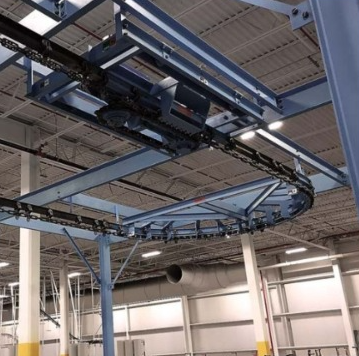
A monorail conveyor is a type of continuous handling system that uses an overhead rail (usually steel) and a set of hanging trolleys to move parts or products along a defined path. This system is widely used in production and assembly lines, painting operations, warehouses, and cold storage facilities. Movement in this system can be either manual or motorized.
⚙️ Technical Specifications (Sample Monorail Conveyor)
System type Overhead monorail (suspended)
Rail type I-beam or special channel profile, epoxy-coated or galvanized
Load capacity per trolley 50 – 500 kg (depending on design)
Trolley material Hardened steel with ball-bearing wheels
Drive type Manual (Push) or Motorized (Power & Free)
Turning radius Custom-designed for curved or U-shaped paths
Travel speed (motorized) Adjustable up to 20 m/min
Control Manual or automatic (PLC & sensors)
Installation type Ceiling-mounted (from structure or roof) or independent with steel framework
🌟 Advantages
Space-saving by utilizing overhead areas
Reduced labor requirements and improved safety
Minimized production downtime and higher efficiency
Capable of long-distance or curved path layouts
Suitable for hot or wet parts (ideal for ovens & washing lines)
Low maintenance cost and long service life
Can be integrated with other production or automation lines
🧰 Common Applications
Coating & Powder Painting Industries: Transfer of parts to spray booth, curing oven, or cooling station
Automotive: Handling bodies, doors, chassis, and bumpers
Metal & Welding: Moving chassis, frames, or metal products
Assembly plants: Connecting multiple assembly stations
Food & Cold Storage: Hygienic transport of carcasses in washable tracks
Forging Conveyor


A forging conveyor is a material handling system used in forging and heat-treatment industries to transfer hot, heavy, or semi-finished parts between production stations. It is designed for high-temperature, harsh environments.
🔧 Technical Specifications
Type Chain, roller, or slat conveyor
Frame material ST37 steel with heat-resistant coating, or alloy steel
Temperature resistance Up to 1200 °C (depending on design)
Load capacity 50 – 500 kg per pallet or part (customized)
Belt width 600 – 1200 mm
Length 3 – 20 meters (customized)
Drive Gearmotor, chain, or hydraulic system
Control Manual or PLC-automated
Track/bed material Refractory steel or cast iron with long service life
🌟 Advantages
High resistance to heat and corrosion
Reduced labor involvement and enhanced safety
Smooth, consistent transport of heavy/hot parts
Reduced production line downtime
Fully customizable to client requirements
High durability and service life
🧰 Applications
Automotive (crankshaft, connecting rods, gears)
Defense and railway industries
Hot forging plants
Preheating & heat-treatment furnaces
Heavy equipment & industrial machinery manufacturers
Liquid Paint Robot


A liquid paint robot is an advanced, fully automated machine for applying liquid paint to metal, plastic, or wooden surfaces. These robots are commonly used in automotive, home appliance, industrial parts, and furniture production. Their operation is based on precise programming of movement paths, paint pressure, and nozzle angle, ensuring uniform coating and reduced paint waste.
🔧 Technical Specifications
Robot type: Articulated industrial arm or SCARA
Spray system: Airless or Air-Mix
Paint delivery capacity: 100 – 500 cc/min (depending on nozzle & pressure)
Controller: PLC with programmable path and paint volume
Axes: Typically 6-axis with high precision (±0.1 mm)
Paint compatibility: Water-based and solvent-based paints
Working pressure: 6 – 10 bar (for Air-Mix)
Nozzle material: Stainless steel or titanium, corrosion-resistant
🌟 Advantages
Improved paint uniformity and surface quality
Reduced paint & solvent consumption
Lower labor costs and minimized human error
Precise, repeatable painting cycles
Safe operation in hazardous (flammable) environments
Quick color-change and setup for different parts
🧰 Applications
Automotive (car bodies, interior parts)
Metal & wooden doors, windows, and cabinets
Home appliances (washing machines, refrigerators, etc.)
Medical & electronic equipment coating
Aerospace and defense industries
Paint waterbooth


A waterfall booth is a chamber with a water-curtain wall designed to capture and filter airborne paint particles. Overspray paint is collected by airflow and the water curtain, keeping the environment clean and reducing paint waste.
🛠 Technical Specifications
Body material Galvanized steel or stainless steel (1.5–2 mm thick)
Dimensions 2 – 6 m (customized)
Filtration type Water circulation or dry filter system
Water pump Anti-corrosion pump sized for booth capacity
Lighting Fluorescent or LED, vapor- and paint-resistant
Exhaust fan High static pressure centrifugal fan
Inspection window For monitoring spray operations
🌟 Advantages
Prevents paint dispersion, improving workplace safety
Allows recovery of unused paint
Produces cleaner, higher-quality surfaces
Reduces cleaning & maintenance costs
Long lifespan, easy maintenance
🧩 Applications
Automotive (body parts & engines)
Metal products (radiators, cabinets, furniture)
Household appliances
Wood/MDF industries (doors, panels)
Military, medical, and electronic equipment
Air Handing Unit

An Air Handling Unit (AHU) is a central HVAC component designed to condition and circulate air in large facilities. It includes fans, cooling and heating coils, filters, dampers, and sometimes humidifiers. Outdoor or return air is filtered, conditioned, and distributed via ductwork. Optional heat-recovery systems can also be integrated.
🛠 Technical Specifications
Body structure Double-skin aluminum/galvanized panels with PU insulation
Frame Aluminum profile, modular and easy to assemble
Static pressure 1000 – 2500 Pa (with >10% margin)
Coils Typically 4–6 rows, with air velocity up to ~450 fps
Airflow capacity Several thousand to >200,000 CFM (≈ 56,000 m³/h)
Noise level Large units ~93–95 dB (e.g., AHU25000P3 @ 650 Pa)
🌟 Advantages
Indoor air quality: removes dust, allergens, and particles (HEPA optional)
Precise temperature & humidity control
Energy efficiency via VAV fans, heat recovery, damper control
Easy maintenance with accessible filters, coils, and fans
Modular design, customizable with coils, humidifiers, and silencers
🧩 Applications
Large buildings (offices, malls, complexes)
Sensitive facilities (hospitals, labs, clean rooms, precision manufacturing)
Industrial (factories, production halls)
Pools & humid spaces (humidity control & mold prevention)
Pistole


Prona RA-200 Automatic Spray Gun
Type: Automatic
Spray width: 320–400 mm
Nozzle size: 1.2 – 2.5 mm (stainless steel)
Paint flow: 270–760 ml/min
Air pressure: 2.5 – 3 bar
Weight: 550 g
Origin: Taiwan
WA-200 Automatic Spray Gun
Feed type Pressure feed
Working air pressure 2.5 – 3 bar (0.24–0.29 MPa)
Air consumption 270–530 L/min
Paint output 270–500 ml/min
Spray width 320–400 mm
Spray distance 250 mm
Weight 500 g
Suitable for Water/solvent-based paints, automotive, wood, glass, construction, agriculture, leather
Features Stainless steel, ergonomic design, robot integration
Nozzle sizes 1.2 / 1.5 / 1.8 / 2.0 / 2.5 mm
WA-101 Automatic Spray Gun
Feed type Pressure feed
Working air pressure 2.4 – 3 bar
Air consumption 190–270 L/min
Spray width 190–255 mm
Weight 460 g
Build Stainless steel body, needle & nozzle, independent pattern/atomizing controls
Suitable for Automotive, home appliances, plastics, pharma, glass, ceramics, textiles, casting, building materials
Features Precise spray control, reduced noise, compact & robot-friendly
🌟 Advantages
Accurate, uniform spray
Suitable for high-precision industries
Compact & lightweight design
Noise reduction during operation
🧩 Applications
Automotive industry
Home appliance & plastics
Pharmaceutical & glass industries
Ceramics & textiles
Printing & casting
U-Type Furnace

A U-shaped furnace is a type of continuous industrial furnace where the material path is designed in a U-shape. This allows space savings and quick return of parts in production lines. Products enter from one side, undergo uniform heating along the U path, and exit from the other.
🔧 Technical Specifications
Geometry U-shape (two parallel arms with return curve)
Fuel type Natural gas, diesel, or electric heating elements
Body material Heat-resistant steel with anti-corrosion coating
Insulation High-density ceramic fiber, refractory silica
Heating system Industrial burners or resistance elements
Temperature control Thermocouples & digital PID controller
Temperature range Up to 800–1200 °C (depending on design)
Dimensions Customizable per production line
Installation Standing, conveyor-linked, or fixed
🌟 Advantages
Saves space compared to straight furnaces
Higher heat efficiency via heat recovery in return curve
Compatible with conveyors or wagons
Precise temperature control along the path
Option for multi-stage burners
Improved production efficiency, reduced energy loss
🧩 Applications
Metal heat-treatment processes
Drying & preheating in painting/coating
Firing glaze or powder coatings
Automotive, steel, ceramics, and heavy industries
Phosphate Pre-treatment System

Phosphate washing is a critical pre-treatment step for metal parts before painting. In this process, the metal surface is treated with special solutions to remove oil, grease, and rust, while forming a phosphate layer that enhances paint adhesion, corrosion resistance, and coating durability.
🔧 Technical Specifications
Process stages 3–7 (commonly 5: degreasing, rinsing, phosphating, final rinse, passivation)
Tank material Stainless steel or galvanized with epoxy coating
Tank capacity 500 – 5000 liters (based on line size)
Heating system Electric elements or steam coils
Operating temperature 45–60 °C
Phosphate type Iron, zinc, or manganese (depending on coating system)
Control PLC automation or manual (thermometer & pH meter)
Spray nozzles Stainless steel, pressure-controlled (for spray systems)
Filtration Mechanical/magnetic filters for sludge removal
🌟 Advantages
Stronger paint adhesion
Prevents rust & corrosion
Prolongs paint coating lifespan
Ensures uniform surface finish
Compatible with powder & liquid paints
🧩 Applications
Automotive
Metal fabrication & cabinet production
Home appliances (refrigerators, washing machines, stoves)
Office/store metal furniture
Powder & liquid coating lines
Grease Trap-Iron Type

A grease trap is a device used to separate grease, oil, and suspended solids from wastewater in kitchens, restaurants, and food industries. Based on density differences between oil and water, it captures grease in a chamber to prevent pipeline clogging and protect sewage systems.
🛠️ Technical Specifications
Body material Carbon steel (St37/St52) with epoxy anti-corrosion coating
Plate thickness 3–5 mm (depending on capacity & pressure)
Capacity 100 – 2000 L/hr (customizable)
Inlet/Outlet connections Flanged or threaded, 2–4 inches
Installation On-ground, underground, or near sinks
Internal coating Epoxy or polyethylene for chemical resistance
Drain valve material Brass or stainless steel
Internal filter Steel or polyethylene plates separating grease & solids
🌟 Advantages
Extends life of plumbing & treatment systems
Reduces maintenance costs of sewage networks
Customizable in different sizes & capacities
High corrosion resistance with industrial coatings
Easy drainage & cleaning
🧩 Applications
Restaurants & industrial kitchens
Ready-meal & fast-food centers
Slaughterhouses & meat packaging plants
Dairy & confectionery industries
Food processing factories
